
Criminal Court Records in Mackinac County
A criminal court record is the case file a court opens once formal charges are filed. It is not the same as a police blotter or a rap sheet. The clerk of the court that hears the case keeps the file, logs every filing, and records the outcome. In Mackinac County two trial courts produce these files. The 92nd District Court starts most cases, and the 11th Circuit Court handles felonies. Both sit in the courthouse in St. Ignace.
The path depends on the charge. Misdemeanors stay in district court from start to finish. Felonies begin in district court too, with the complaint, the warrant request, the arraignment, the probable-cause conference, and the preliminary examination. If the judge finds probable cause, the case is bound over to circuit court, and the prosecutor files a document called the Information. From that point the felony file lives in circuit court through plea, trial, and sentencing. For a closer look at the offenses themselves, see the Mackinac County arrest records and court charges page. The criminal case file is one slice of the broader set of Mackinac County court records.
How to Search Mackinac County Criminal Court Records
The first online stop for Mackinac County criminal court records is MiCOURT Case Search, run by the Michigan Judiciary. Depending on the court, it may return criminal, traffic, civil, domestic, and probate cases. Coverage depends on which court took part, so a name that returns nothing online may still have a paper file at the courthouse.
- Open MiCOURT Case Search and choose the court that fits the charge: circuit for felonies and serious misdemeanors, district for most misdemeanors and traffic crimes.
- Search by case number first if you have one from a citation, a notice, or a court paper.
- If you only have a name, enter the full legal last and first name, then narrow by court type or filing year.
- Open the case to read the register of actions, the charges, each hearing, and the disposition.
- Ask the clerk of that court for a certified copy, since a printout from the search is not certified.
A certified copy always comes from the clerk of the court that holds the file. That is the County Clerk for circuit cases and the 92nd District Court counter for district cases. When a case does not appear online, a phone call to that court is the next step, because older files and some case types are not in the public online index.
Stages of a Mackinac County Criminal Case
A criminal case moves through set steps, and each step leaves a mark in the file. Reading the record in order shows where a case stands and how it got there. The flow below is the path a felony takes from the first filing to the final penalty.
Case flow: Charges Filed › Arraignment › Probable-Cause Conference / Preliminary Exam › Bindover › Plea or Trial › Disposition › Sentencing
- Arraignment
- The first hearing, where the court reads the charge and sets bond and the next dates.
- Probable-Cause Conference
- A felony step in district court to weigh the case and discuss a plea or the exam.
- Preliminary Examination
- A district-court hearing that tests whether a felony has enough proof to go forward.
- Bindover
- The order that sends a felony up to circuit court after probable cause is found.
- Disposition
- The result of each charge, such as a plea, a verdict, or a dismissal.
- Sentencing
- The penalty the judge imposes once a conviction is entered.
What a Mackinac County Criminal Court Record Shows
A criminal court record is built around the register of actions, a dated list of every filing and event. The fields below reflect the typical Michigan case file. No live Mackinac sample was viewable during research, so treat the list as the common core rather than an observed county screen.
| Field | What It Shows |
|---|---|
| Case Number | The court's unique key for the file, printed on every notice and paper. |
| Court | The 11th Circuit, the 92nd District, or the court that owns the case. |
| Parties | The People of the State of Michigan on one side and the defendant on the other. |
| Charges | Each offense, its statute citation, and whether it is a felony or misdemeanor. |
| Plea | The defendant's answer, such as guilty, not guilty, or no contest. |
| Disposition | The final result of each charge in the case. |
| Sentence | Any jail, prison, probation, fines, costs, or restitution. |
Note: Online results often list these register entries without the underlying document images, which usually stay at the clerk counter.
Reading Dispositions in Mackinac County Criminal Records
The disposition is the heart of a criminal court record. It tells you how each charge ended. A single case can hold several charges, and each one can end in a different way, so read them one by one.
- Guilty - a plea or verdict of guilt that becomes a conviction.
- Not guilty - an acquittal at trial, which leaves no conviction on that charge.
- Dismissed - the charge is dropped, either with prejudice or without.
- No contest - the defendant accepts the penalty without admitting guilt.
- Deferred - judgment is held back and may be wiped if the terms are met.
The sentence sits next to the disposition. It may list jail time in the county, a prison term served through the state, probation, fines, court costs, and restitution to a victim. Reading both together shows not just the result but the price the court set.
The Prosecutor's Role in Mackinac County Criminal Cases
Charges do not come from the police. In Michigan the Prosecuting Attorney reviews police reports, decides what to file, and represents the People of the State of Michigan in court. Mackinac County uses the title Prosecuting Attorney, not District Attorney.
The office of the Mackinac County Prosecuting Attorney lists the current prosecutor and its contact details.
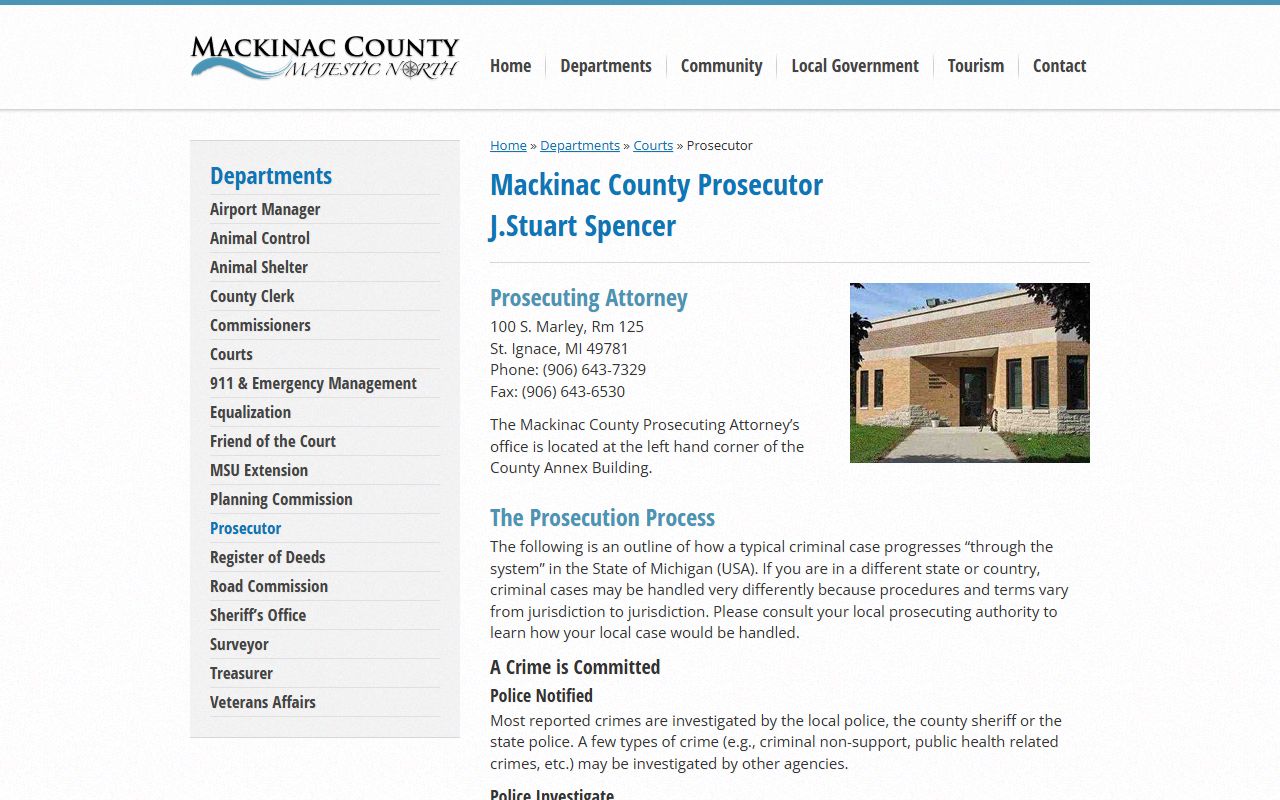
That office decides whether a charge is filed, amended, reduced, or dropped, so charging questions belong there rather than with the court clerk. The prosecutor handles felonies in circuit court and misdemeanors in district court.
Prosecuting Attorney
J. Stuart Spencer
100 S. Marley Street, Room 125
St. Ignace, MI 49781
(906) 643-7329
Charges vs. Convictions
Being charged is not the same as being convicted. A criminal court record can show charges that were dropped, dismissed, or that ended in an acquittal. Reading the two apart keeps you from misjudging a file.
| Charge | Conviction | |
|---|---|---|
| Stage | Accusation | Verdict or plea |
| Burden of Proof | Probable cause | Beyond a reasonable doubt |
| Public Record | Yes | Yes |
| Effect | No finding of guilt | Finding of guilt entered |
Note: A dismissal without prejudice can be refiled, so an old dismissed charge does not always mean the matter is closed for good.
State Criminal History and Mackinac County Criminal Files
A statewide check is different from a single county file. The Michigan State Police keep a public criminal history that pulls from courts across the state. It is called ICHAT.
The Michigan State Police criminal history record service explains how a statewide ICHAT search works.
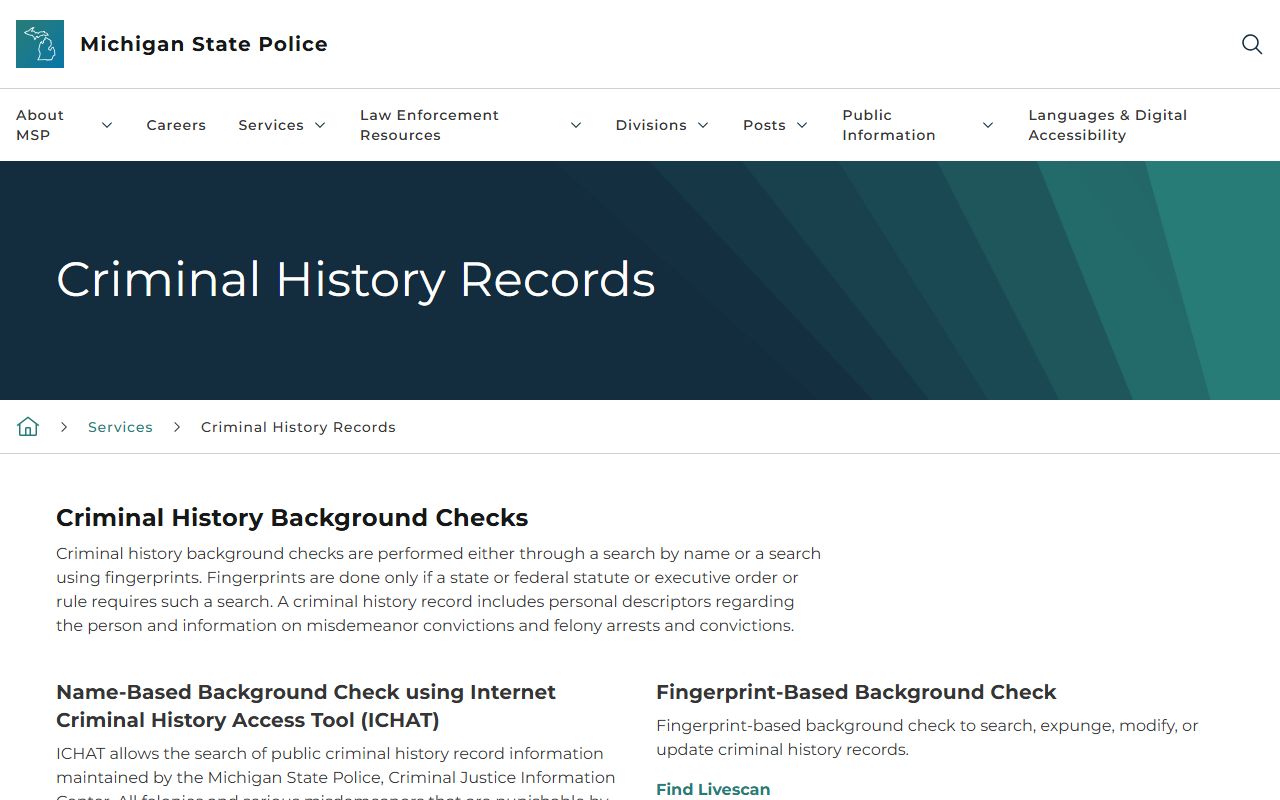
ICHAT is not a court docket. It shows convictions and some pending charges statewide, but it does not include warrant information or sealed records, and it stands apart from any single Mackinac County criminal court file.
Use ICHAT when you need a broad background result rather than one case. For the full detail of one matter, the court file still wins, because it holds the motions, the hearings, and the sentence in full.
Setting Aside a Conviction Under Clean Slate
Michigan lets people clear some convictions from public view. The process is called a set-aside, and the Clean Slate law expanded it.
The Michigan State Police Clean Slate page describes both automatic and application-based set-asides.
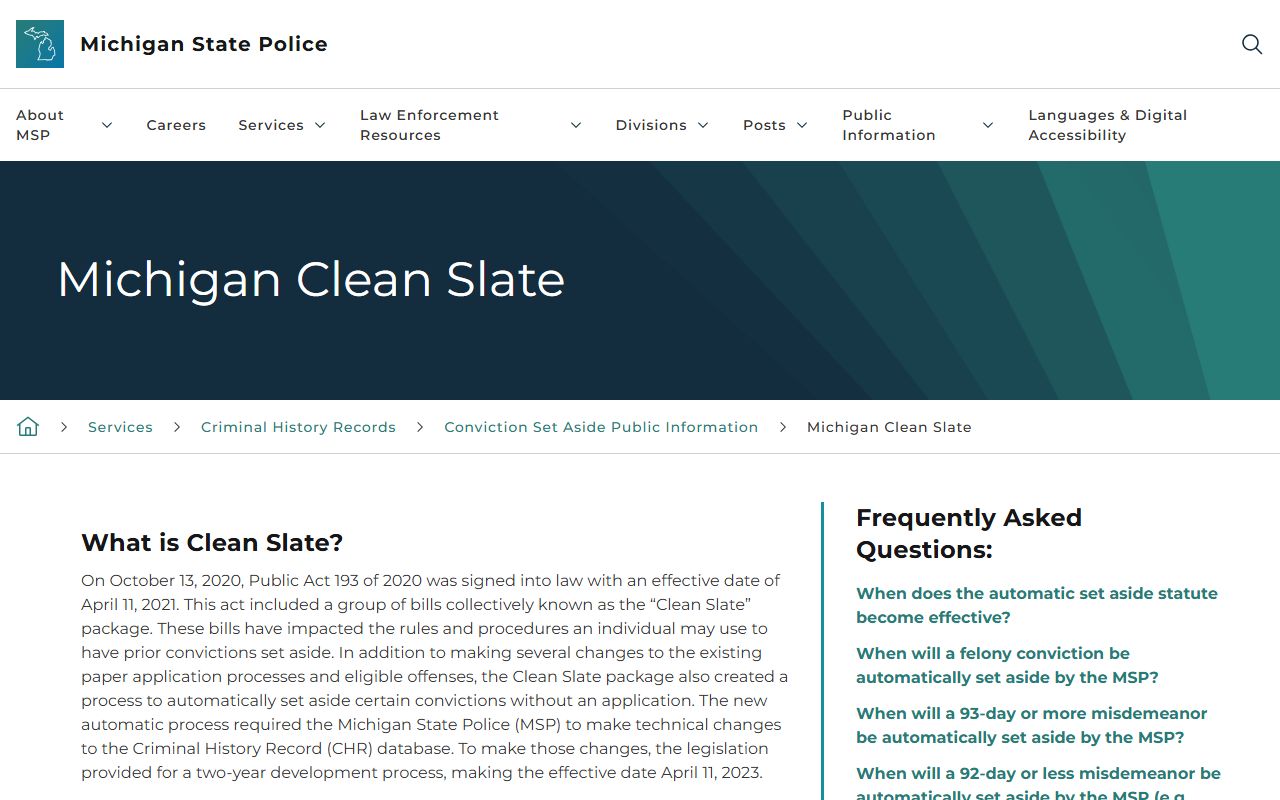
Automatic set-asides depend on the offense, the waiting period, and a clean record over time, while other cases still need an application to the court of conviction.
A Mackinac County case routes to the court that entered the conviction, the 92nd District Court for eligible misdemeanors and the 11th Circuit Court for felonies. One limit matters for drivers. Under MCL 780.621c, a traffic set-aside does not force the Secretary of State to erase the item from your driving record, so the court file and the driving record can tell different stories.
Note: A set-aside changes public criminal history access, but courts and law enforcement may still see the record for limited, lawful purposes.
Sealed vs. Set Aside or Expunged Records
People often blur three terms. A sealed record is hidden by law or court order. A set-aside, Michigan's version of expungement, treats a qualifying conviction as removed from public criminal history. The table sets them side by side.
| Sealed | Set Aside / Expunged | |
|---|---|---|
| Visibility | Hidden from public view | Removed from public criminal history |
| Law Enforcement | Limited access remains | Limited access for lawful uses |
| How It Happens | Court order or statute | Automatic or by application under Clean Slate |
| Eligibility | Case-specific, set by the court | Offense type and waiting period under MCL 780.621 |
Federal Criminal Cases Involving Mackinac County
Not every case near the Straits is a state case. Federal crimes are prosecuted in the U.S. District Court for the Western District of Michigan, and Mackinac County falls in that district. The nearest federal courthouse in the Upper Peninsula sits in Marquette.
The U.S. Attorney's Office for the Western District of Michigan handles federal prosecutions across the region, including the Upper Peninsula.
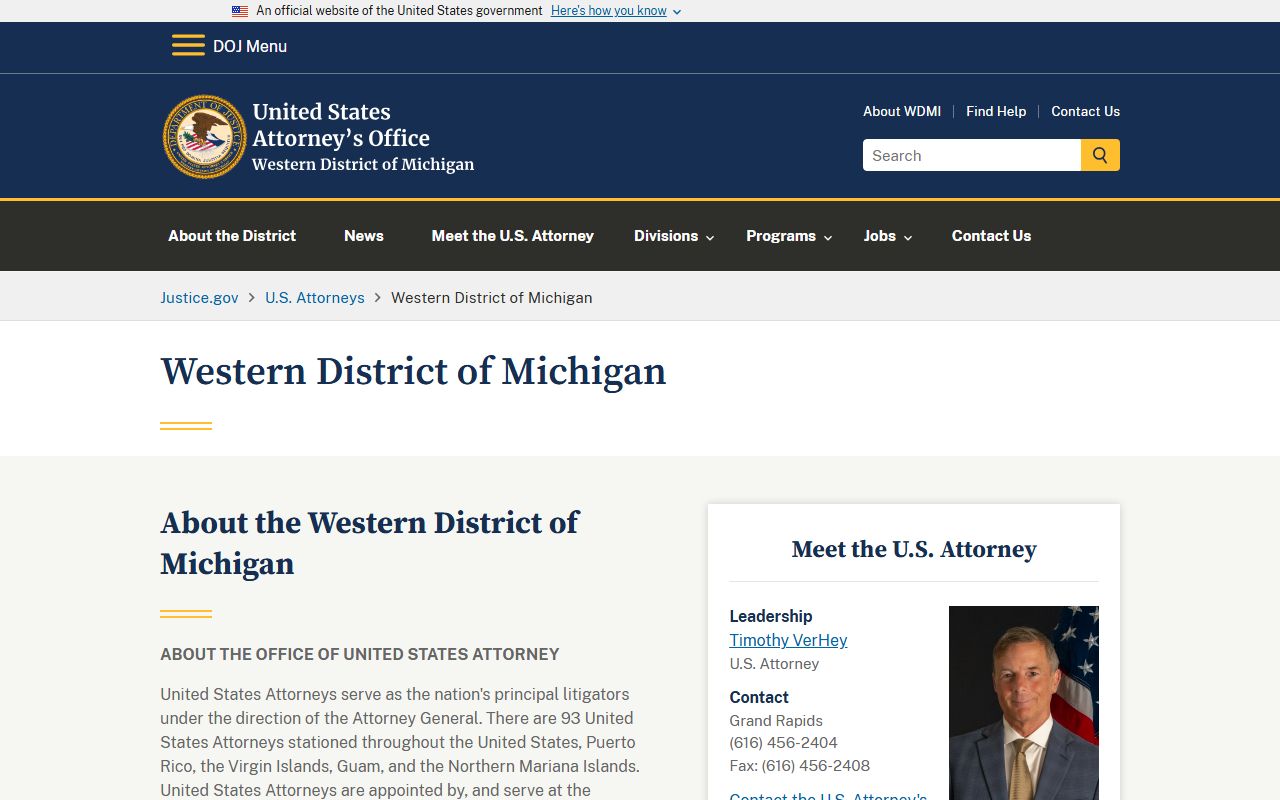
Federal files are searched through PACER, not through MiCOURT or the county clerk, so a federal case leaves no record in the Mackinac County court system.
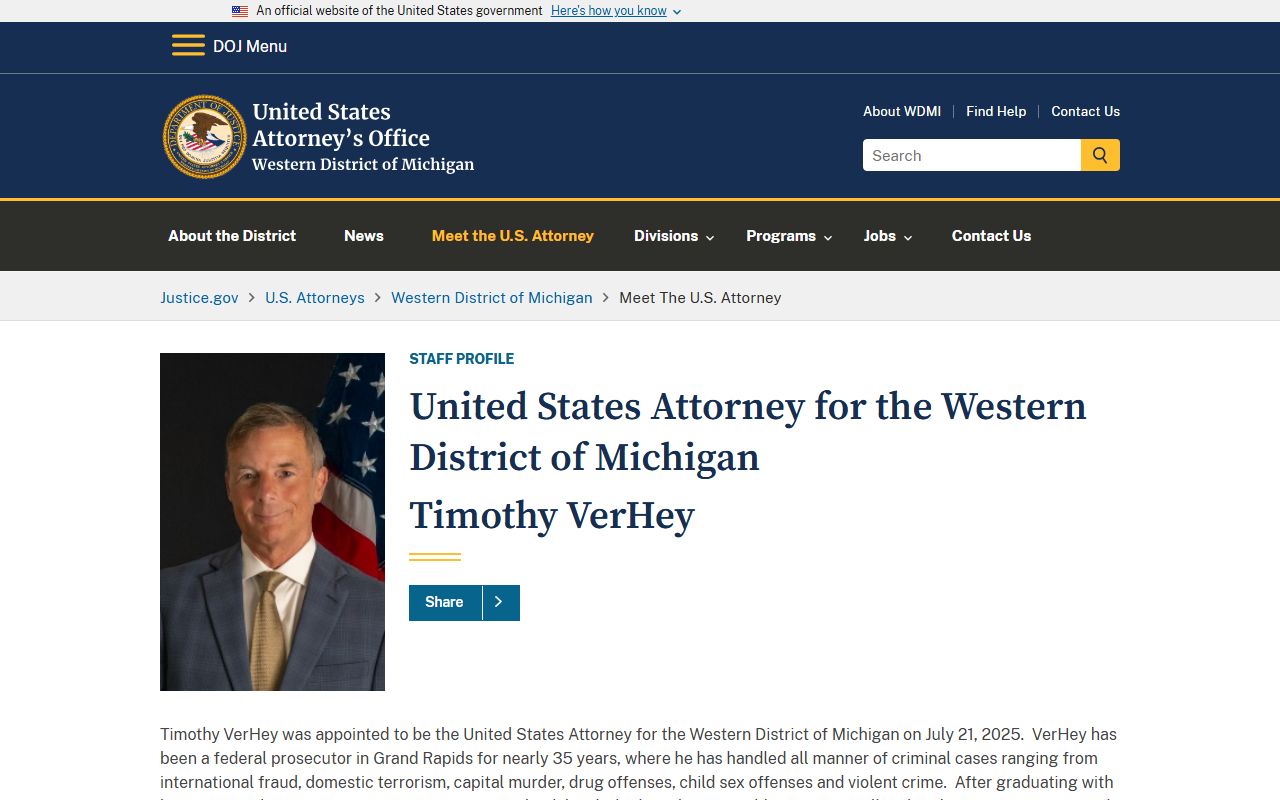
The office's U.S. Attorney profile names the appointed lead prosecutor for the district.
For a Mackinac County resident, a federal charge and a state charge run on wholly separate tracks, with separate courts, dockets, and record systems.
Public Access to Mackinac County Criminal Court Records
Two frameworks control access. Court files follow Michigan court rules, and the clerk decides how case records are viewed and copied. County records that are not court files, such as sheriff policies, follow the Freedom of Information Act through the County Clerk.
Key Statutes:
Michigan FOIA, MCL 15.231 - the state declares that people are entitled to full information about government affairs, subject to exemptions.
Michigan Court Rule 8.119 - clerks maintain court records, and access follows court rules rather than county FOIA alone.
For county records that are not court files, the FOIA path runs through the County Clerk at Room 10 in the courthouse, with a five business day response window.
Restricted Mackinac County Criminal Court Records
Not every Mackinac County criminal court record is open. Juvenile cases in the Family Division are shielded, and access usually belongs to parties, parents, attorneys, and authorized agencies. Sealed cases and set-aside convictions may drop out of public search tools.
Some parts of an open file are still masked. Social Security numbers, birth dates, minor names, and protected addresses are often redacted, even in an otherwise public record. To view a restricted file, an eligible person can petition the court that holds it.
Background Check Considerations
A casual name search is not a background check. Employers, landlords, and lenders who rely on a report must follow the federal Fair Credit Reporting Act, which sets rules for accuracy, notice, and consent. A quick court lookup does not meet that standard, and a court record can lag behind the paper file after a plea, a recall, or a new order.
Important: This resource is not a consumer reporting agency under the Fair Credit Reporting Act, and its data may not be used for credit, employment, tenant, or insurance decisions.