
Mackinac County Arrest Records and Court Charges
A Mackinac County arrest record is the account of an arrest itself. It names the arresting agency, the date, and the reason for the stop or booking. In this county the Sheriff's Office, led by Sheriff Edward M. Wilk, runs the jail and books most people held in the eastern Upper Peninsula. Booking creates the custody entry. The arrest does not decide guilt. It only starts the process. Once the report reaches the Prosecuting Attorney, that office weighs the facts and files the charges with the court clerk. From that point the court charge record begins and moves with the case.
The booking side and the charge side live in different places. Custody detail, such as who is held in the jail right now, sits on the sheriff's side, and Mackinac County publishes no online roster, so the jail phone line is the practical check for current custody. The Mackinac County inmate records page covers the jail roster and booking detail. The court charge record, by contrast, is what the prosecutor filed and how the court acted on it. Court charges after arrest are tracked through the case file from first appearance to the final order.
The county Sheriff's Office page describes the agency that books and holds people before their charges reach a courtroom, as shown on the Mackinac County Sheriff's Office page.
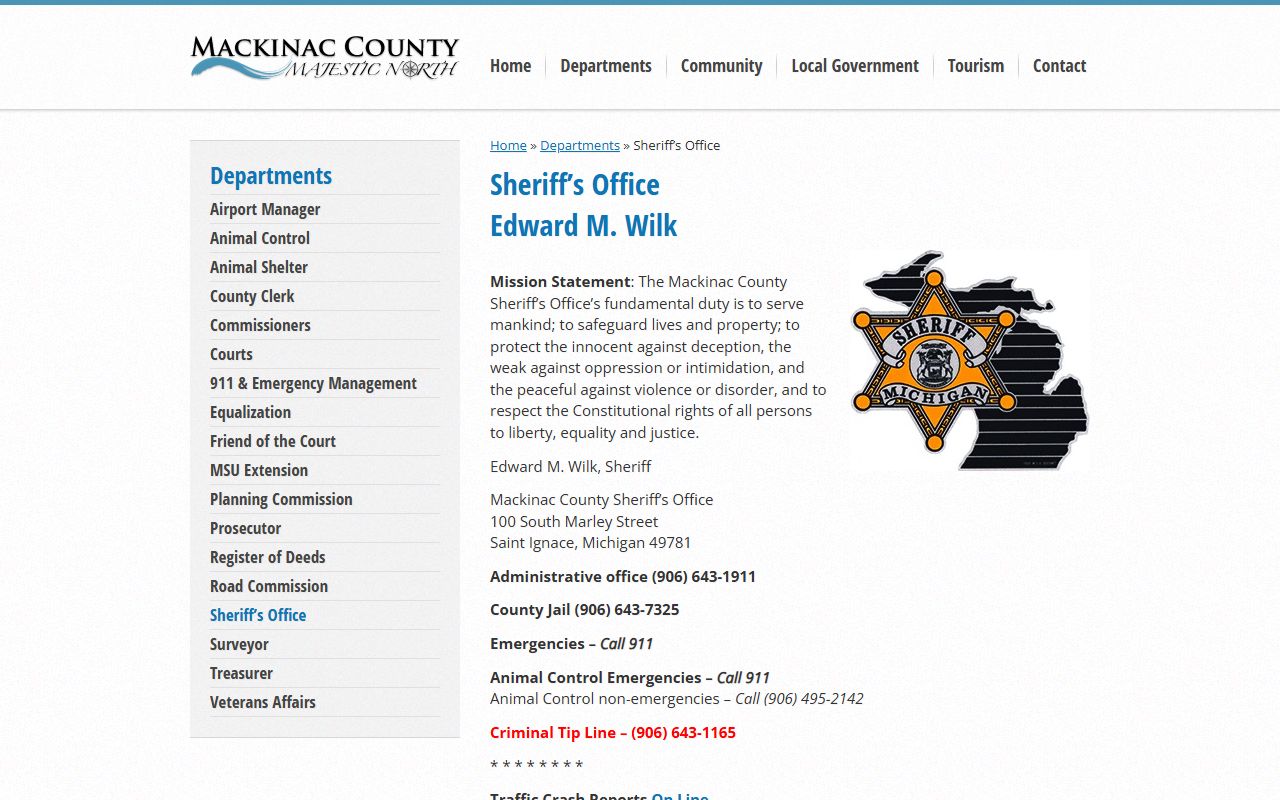
That office handles the arrest and custody stage, while the prosecutor and the courts handle the charges that grow out of it.
How to Find Mackinac County Arrest Records and Charges
Mackinac County charges appear in the court case record, not in a public arrest blotter. The first online stop is MiCOURT Case Search, the statewide court portal. Coverage depends on the court and the case type, so a search may return a full history or nothing at all. When the portal comes up short, the court clerk holds the file. The steps below outline a name or case-number search.
- Open MiCOURT Case Search and pick the right court path: district for misdemeanors and early felony steps, circuit for felonies after bindover.
- Search by the defendant's full legal name, or by case number if it appears on a notice, ticket, or court paper.
- Open the matching case and read the list of charges filed against the person.
- Check each charge for its statute code, its level, and its current status, such as pending, amended, or dismissed.
If the case is not online, call the court that owns it. The 92nd District Court handles first charges, arraignment, and misdemeanors, while the 11th Circuit Court holds felony files after bindover. For a statewide view of past charges that ended in a conviction, the Michigan State Police run a separate criminal-history search, covered further below.
How Mackinac County Charges Get Filed After an Arrest
The charge record begins when the prosecutor files a charging document. Michigan uses three main types. The one that applies depends on how serious the offense is and how the case moves through court. Most cases start with a complaint. A felony that clears a preliminary examination moves forward on an information. Grand jury indictments are rare in Michigan and are saved for a narrow set of matters.
In Michigan the charging decision belongs to the Prosecuting Attorney, not a district attorney. Mackinac County's Prosecuting Attorney, J. Stuart Spencer, reviews police reports, decides whether the evidence supports a charge, and files it on behalf of the People of the State of Michigan. The office handles felonies in circuit court and misdemeanors in district court. Only the prosecutor sets the formal charge, so the offense an officer notes at arrest can differ from what finally lands on the court record.
| Complaint | Information | Indictment | |
|---|---|---|---|
| Filed By | Officer / Prosecutor | Prosecutor | Grand Jury |
| Common For | Misdemeanors | Many felonies | Serious felonies |
| Starts | The case | The case | The case |
Note: A Michigan felony usually starts on a complaint in district court, then moves onto an information in circuit court once a judge finds probable cause at the preliminary examination.
Charge Status in Mackinac County Court Records
Charges rarely stay frozen. As a case moves, a charge can be amended, reduced, added, dropped, or dismissed. Reading the status tells you where the charge stands right now. A felony charge may also be bound over, which means the district court sent it up to circuit court. The table below defines the common status terms in a Mackinac County case file.
| Status | What It Means |
|---|---|
| Pending | The charge is filed and the case is still open, with no final ruling yet. |
| Amended / Reduced | The prosecutor changed the charge, often to a lower offense as part of a plea deal. |
| Dismissed | The court dropped the charge, and it no longer moves toward a conviction. |
| Nolle Prosequi | The prosecutor chose not to pursue the charge, ending it without a verdict. |
| Bound Over | The district court found probable cause and sent the felony charge to circuit court. |
Charges vs. Convictions
An arrest and a charge are not proof of guilt. A charge is an accusation that must still be proven. A conviction is the result, entered only after a plea or a verdict. A person can be charged and later cleared, and the record may still show the original charge. The final outcome, including any plea and sentence, sits in the Mackinac County criminal court records file.
| Charge | Conviction | |
|---|---|---|
| Stage | Accusation | Verdict or plea |
| Burden of Proof | Probable cause | Beyond reasonable doubt |
| Public Record | Yes | Yes |
Sealed and Expunged Mackinac County Records
Some Mackinac County records are closed to public view. Michigan law lets a person set aside, or expunge, a qualifying conviction so it no longer shows in a public criminal-history search. Sealing hides a record; expungement treats it as though it never happened for most purposes. Eligibility turns on the offense, the waiting period, and whether the conviction clears automatically under the state Clean Slate program. Traffic offenses carry a special limit, and a set-aside there does not force removal from the state driving record.
| Sealed | Expunged | |
|---|---|---|
| Visibility | Hidden from public | Treated as never existed |
| Law Enforcement | Limited access | Very limited |
| Eligibility | By court order or statute | Set-aside under MCL 780.621 and Clean Slate |
Mackinac County Charge Codes and Severity Levels
Every charge points to a specific law. Michigan charges cite a section of the Michigan Compiled Laws, and that code sets both the offense and its level. Levels run from civil infractions, which are not crimes, up through misdemeanors and felonies. A misdemeanor carries a shorter jail term or a fine. A felony carries the risk of state prison. One arrest can produce several separate charges, each with its own code and level, so a single case file may list more than one offense. Michigan splits misdemeanors into shorter and longer types, with many capped at ninety-three days in jail and others reaching up to a year. Felonies are grouped by their maximum term, so the code and the possible sentence travel together. The severity level also decides which court hears the case, with felonies moving to the 11th Circuit Court after the district court steps are done.
Statewide Charge and Criminal History Lookups
Mackinac County charges that end in a conviction roll up into a statewide criminal-history record. The Michigan State Police run the Internet Criminal History Access Tool, known as ICHAT, for public criminal-history searches across the state. A name search there returns conviction history, not open arrest detail. The tool at the Michigan State Police criminal history page charges a set fee per search, paid online. ICHAT does not include warrant information, and it does not show suppressed or set-aside records. For charges tied to one specific case, the court file stays the better source, since ICHAT reports the statewide history rather than the day-to-day docket.
Mackinac County Records Requests for Arrest Information
Some arrest information is held by the county rather than a court. Sheriff reports, correspondence, and other county records fall under the Michigan Freedom of Information Act. The County Clerk serves as the county FOIA Coordinator and takes written requests by mail, in person, fax, or email. A request must describe the records well enough for staff to find them. The county answers within five business days, though it may take a ten-business-day extension.
The Michigan Attorney General explains the state's public-records law and what a public body must disclose, as laid out on the Michigan Attorney General FOIA page.
That framework sets the ground rules the County Clerk follows when releasing county-held arrest information. Fees stay modest, with standard copies capped at a dime a sheet and labor billed only in fifteen-minute blocks.
Note: Records tied to an active investigation may be withheld or redacted, so a FOIA request will not always release an open arrest or charge file.
Background Check Considerations
A casual name lookup is not the same as a background check. Employers, landlords, and licensing bodies that run formal checks must follow the federal Fair Credit Reporting Act. That law sets rules on accuracy, consent, and how old records may be used. A quick Mackinac County court search can miss sealed cases, amended charges, or the final outcome. For any decision about a job, a lease, or credit, a regulated screening service is the correct route.
Important: Public arrest and charge records must not be used for employment, housing, credit, or other screening covered by the Fair Credit Reporting Act, since those uses require a licensed consumer reporting agency.
Restricted Charge Records in Mackinac County
Not every Mackinac County charge record is open. Juvenile charges are shielded, since family-division and juvenile matters are not public like adult cases. Sealed and set-aside records drop out of public search tools. Adoption files are confidential. Dismissed charges may still appear in a court file, though a set-aside can pull a qualifying one from public criminal history. Active investigations stay out of reach until a case is filed.
Michigan's Freedom of Information Act policy section states that people are entitled to full information about government affairs, subject to exemptions, as recorded in the Michigan FOIA policy section.
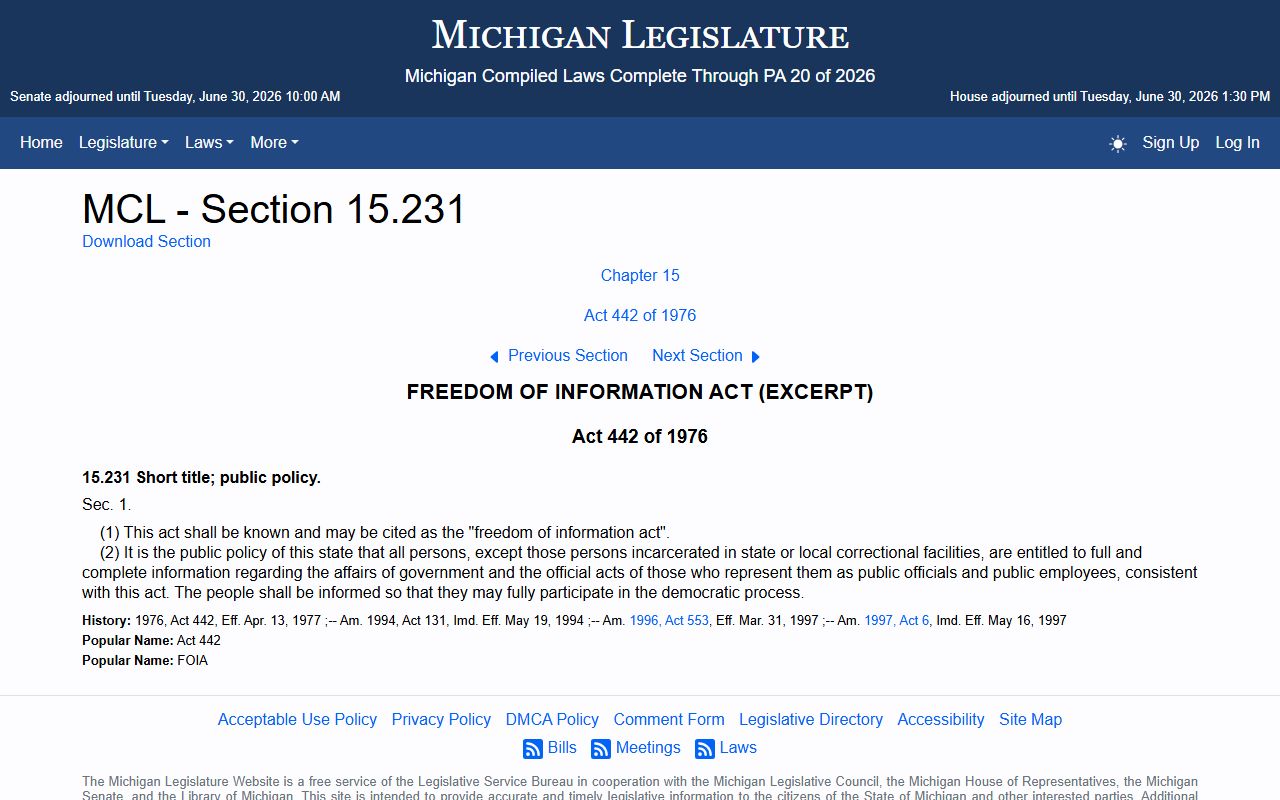
Those exemptions are why juvenile, sealed, and open-investigation charge records stay closed even when most court files are public.